
Quick answer
Google supports one favicon per hostname. The image must be square and at least 8×8; Google recommends larger than 48×48. Both the homepage and icon must be crawlable.
- Last verified
- July 31, 2026
- Evidence
- Primary documentation plus transparent editorial analysis
- Primary sources
- 1
Eligibility requirements
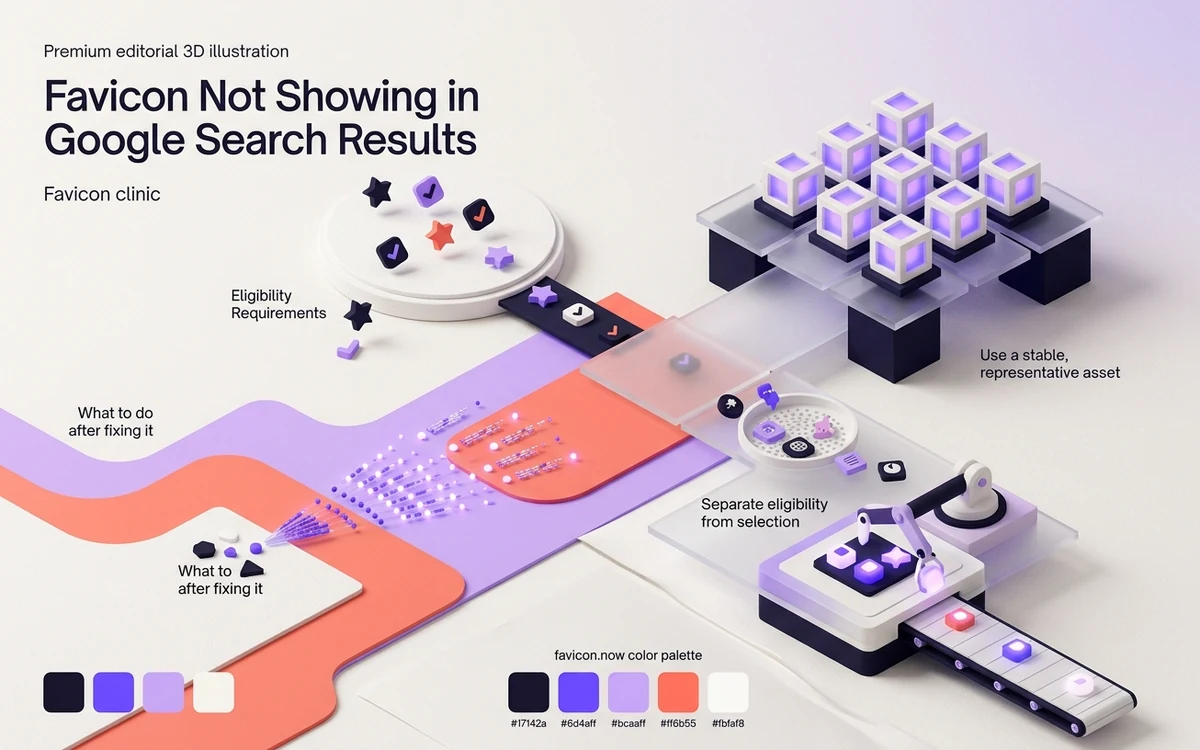
Google supports one favicon per hostname. The image must be square and at least 8×8; Google recommends larger than 48×48. Both the homepage and icon must be crawlable.
Connected next stepFavicon Not Showing? Diagnose It in Seven Checks for the closest prerequisite or comparison.
Use a stable, representative asset
Keep the icon URL stable, avoid inappropriate imagery, and use a mark that clearly represents the site. Link it from the homepage head with rel=icon.
Connected next stepCan Different Pages Use Different Favicons? for the next connected implementation decision.
What to do after fixing it
Request the homepage and icon as Googlebot-compatible public resources, update the head markup, and let Google recrawl. Search appearance is not an instant cache purge and is not guaranteed.
Connected next stepRun the Google-specific eligibility checks and verify the decision with a working output.
Separate eligibility from selection
Eligibility requires a crawlable homepage and favicon, a supported image, square geometry, and a stable URL associated with the site. Passing those checks means Google can consider the icon; it does not guarantee immediate selection or display.
Use the live URL rather than a source-repository path. Verify that robots rules, CDN policy, authentication, and hotlink protection allow Google to fetch the actual image.
Keep a recrawl evidence log
Record the date the homepage markup and favicon bytes became correct, the canonical homepage URL, the submitted sitemap, and Search Console’s last crawl. Avoid changing the favicon URL again while waiting, because each change creates a new discovery target.
Request homepage indexing after deployment and monitor appearance over subsequent crawls. Browser-tab success is useful transport evidence but does not reveal Google’s refresh schedule.
Apply this guide with the relevant tools
Use the smallest tool that verifies the specific decision described above. Each destination keeps the source format, deployment evidence, or platform purpose explicit.
Review the headings, sources, implementation artifact, and update record for this guide as structured JSON.
Download guide evidence ↓- Guide
- Favicon Not Showing in Google Search Results
- Coverage
- Client behavior can change by browser, operating system, platform version, cache state and deployment configuration. Unperformed manual observations are not claimed.
Questions, answered
Can I force Google to refresh it?+
No. You can make the setup crawlable and request indexing of the homepage, but display and timing remain Google’s decision.
Can subdirectories have separate search favicons?+
No. Google defines the site at hostname level for this feature.