Google Favicon Checker for Search Eligibility
Fetch the homepage and real favicon candidates, then evaluate crawlable responses, square geometry, supported decoding, and Google’s 48-pixel size recommendation.

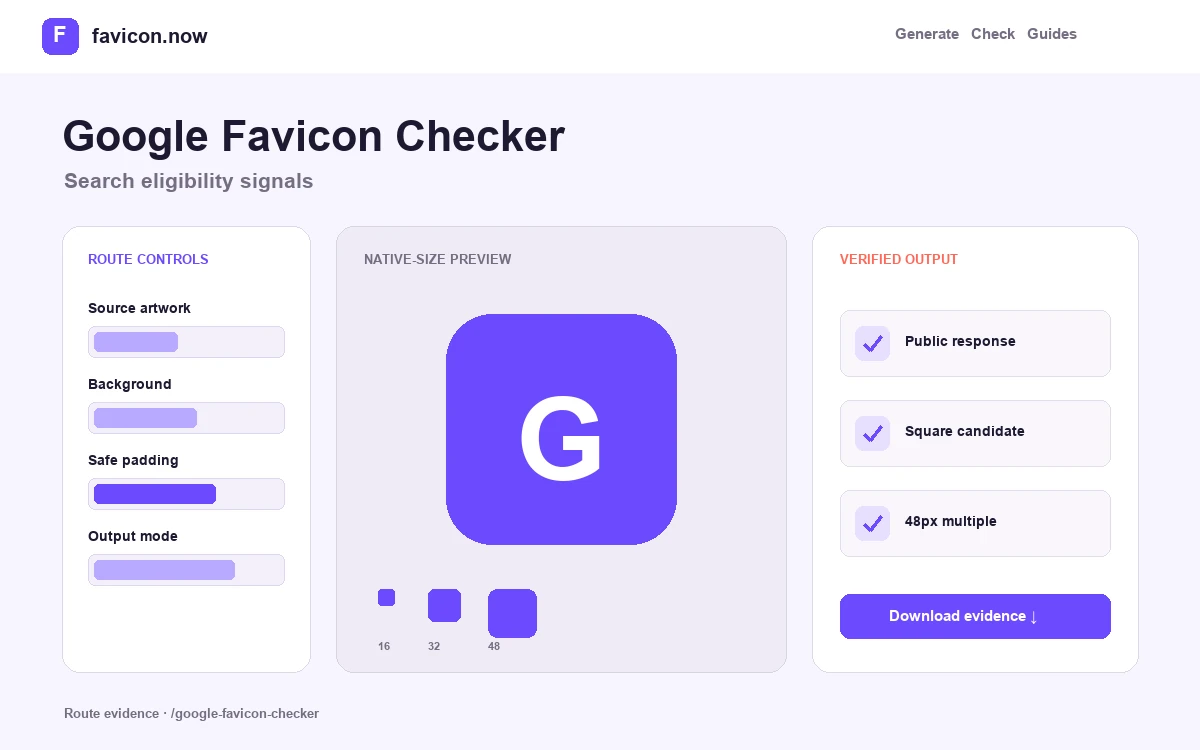
What this Google-specific favicon check can prove
The report identifies favicon candidates discovered from the submitted homepage, requests their real public URLs, confirms whether the bytes decode as supported images, and checks for square dimensions. It separately highlights candidates whose dimensions are multiples of 48 pixels, following Google’s published recommendation.
Crawlable response
The homepage and candidate need public responses that Googlebot can request. A login wall, blocked asset, redirect failure, HTML response, or invalid image prevents dependable processing.
Square supported artwork
The icon must be square and at least 8×8 pixels. A larger multiple of 48 pixels is recommended, while SVG can remain scalable when it is valid and publicly accessible.
Eligibility is not selection
A passing technical result cannot force Google to display or refresh a favicon. Stable URLs, hostname-level consistency, recrawling, and Google’s own processing still determine the visible result.
Run the Google favicon audit in the right order
- Submit the canonical HTTPS homepage, not an internal article, staging host, or URL that requires authentication.
- Confirm that the homepage returns indexable HTML and exposes a favicon declaration in its rendered head.
- Open the resolved favicon URL directly and verify status, final URL, Content-Type, decoded format, and square dimensions.
- Prefer a stable candidate whose raster dimensions are a multiple of 48 pixels, or a valid scalable SVG with an appropriate fallback.
- Keep the homepage and favicon crawlable, deploy consistently across the hostname, and allow time for Google to recrawl and process the change.
How to act on each finding
A missing declaration belongs in the shared homepage head. A 404, login response, or HTML body at the icon URL is a transport or routing problem. A non-square file must be recomposed, not merely renamed. A valid 32×32 candidate can work in browsers but does not follow the larger 48-pixel-multiple recommendation for search presentation.
If every technical check passes and Google still shows the previous image, stop rotating files during diagnosis. Confirm that the canonical homepage consistently declares the stable URL, inspect the live page in Search Console, request recrawling through the verified property when appropriate, and monitor the result. Favicon selection and refresh timing remain Google-controlled.
This tool evaluates public technical signals at request time. It does not impersonate Googlebot, access private Search Console data, guarantee indexing, or predict whether Google will select the candidate for a particular result.
Google favicon checker questions
Does a passing report guarantee a favicon in Google Search?+
No. It establishes technical readiness for the checks the tool can observe; Google controls recrawling, processing, selection, and display.
Should I change the favicon URL to force a refresh?+
Use a stable production URL when possible. Repeated URL changes can make diagnosis harder; first prove the current response and declaration, then allow recrawling.
Why test the homepage rather than an article?+
Google’s favicon guidance is host-oriented and relies on the site homepage for discovery. Internal-page markup cannot repair an inaccessible or inconsistent homepage candidate.
From favicon idea to verified deployment
Follow one clear path through creation, inspection, installation, and troubleshooting.