
Quick answer
Historically, browsers discovered the favorites icon at /favicon.ico. Some browsers, crawlers, PDF viewers, and embedded clients continue to request that conventional path.
- Last verified
- July 31, 2026
- Evidence
- Primary documentation plus transparent editorial analysis
- Primary sources
- 1
The automatic root request
Historically, browsers discovered the favorites icon at /favicon.ico. Some browsers, crawlers, PDF viewers, and embedded clients continue to request that conventional path.
Connected next stepHow to Clear a Stubborn Favicon Cache for the closest prerequisite or comparison.
The clean fix
Serve a valid ICO at the root and also declare your preferred modern SVG or PNG icons. This keeps logs clean and improves compatibility.
Connected next stepHow to Add a Favicon to an Express Node.js App for the next connected implementation decision.
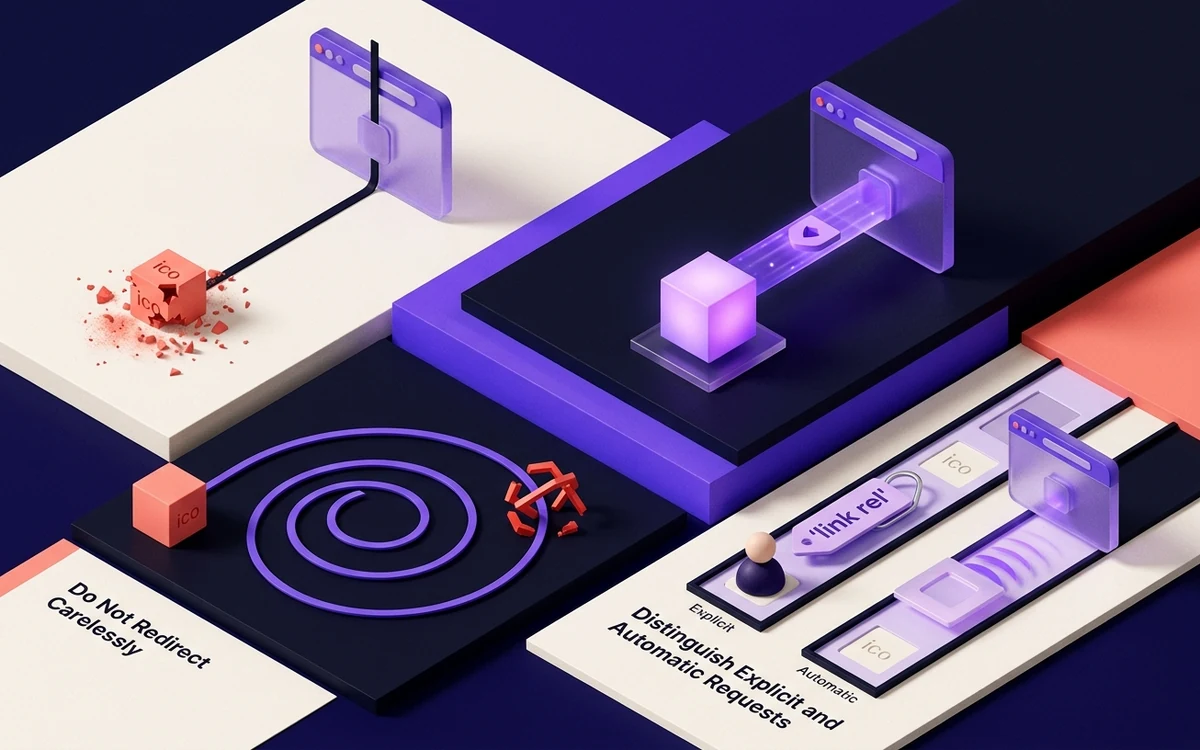
Do not redirect carelessly
A short permanent redirect to a stable icon can work, but direct serving avoids extra requests and MIME surprises.
Connected next stepOpen the most relevant production tool and verify the decision with a working output.
Distinguish explicit and automatic requests
A declared href returning 404 is an HTML or deployment defect. A request for /favicon.ico can also occur when a client probes the conventional root even without a link element, so serving a small valid root file prevents noisy logs and weak fallbacks.
Do not redirect the ICO request to an HTML page, login screen, or image route that changes format without a correct MIME type.
Trace framework and proxy routing
Confirm that the static-file layer receives the request before a front controller, catch-all application route, authentication middleware, or SPA fallback. Case-sensitive filenames and path prefixes often differ between local and production systems.
Use curl or the live checker to record the final URL, redirect chain, status, and Content-Type. A 200 response containing the 404 page is still a failed icon.
Review the headings, sources, implementation artifact, and update record for this guide as structured JSON.
Download guide evidence ↓- Guide
- Why Browsers Request /favicon.ico—and How to Stop the 404
- Coverage
- Client behavior can change by browser, operating system, platform version, cache state and deployment configuration. Unperformed manual observations are not claimed.
Questions, answered
Can I return 204?+
You can suppress the error, but you also discard a useful compatibility surface.
Why is it requested on API routes?+
The browser associates the icon with the origin, not only the HTML page that initiated navigation.